Showing posts with label dogs. Show all posts

Friday, 26 June 2009

The heartbreaking persistence of nature

Perfect sultry day, air thick as honey. A day for lying on the grass folded in the arms of a lover. For stroking damp hair from a sweated forehead. For cool crisp white wine and soft summer fruits dipped in sugar. For watching leavening clouds growing dense as charcoal. For laughing as slow swollen rain drops explode on the skin and running for cover under newspaper umbrellas. For ice creams, choc ices, kiss-me-quick hats and long cotton skirts. For barefooted footsteps, flip flops and wriggling scarlet varnished toes in the sand.

A crow stands on a chimney pot, king of all he surveys. Ragged jet wings and glistening beak full of discarded sandwich crusts. He feeds his young as tenderly as the gentlest cow nuzzles her calf, then arches his wings and leaps into the air in an act of faith as old as time. To us earth-stuck creatures, who can gaze only with envious eyes as he soars and swoops with a natural grace, his flight is a miracle.


In the high street, engines grind and rumble as cars and lorries inch their way towards the end of the work week. Office workers run lunch time errands, hair slick with sweat and make-up melting on burning cheeks. Music seeps through open windows, snatches of conversation, of badly tuned radios and exotic languages. Pigeons squabble over market remains on the edge of the pavement. Fresh black graffiti on the face of a white painted building, mismatched curtains hang limp at its dusty windows. A man chews his nails as his van waits to turn at the lights, his mind fixed on the long cold beer and the quick hot kiss to welcome him home.

Sunset on the beach and the hazy mist of night time heat blurs an invisible line between sea and sky. Herring gulls strut and peck on the shingle bank picking out oysters and winkling crabs. It is quite quite still; even the incoming ocean raises barely a ripple in the storm heavy air. Swifts chase overhead darting on the trails of hazy insects and the bulging vapours of mesmeric midges. Oystercatchers call to each other from the hem of the tide among the driftwood and the bladder wrack. The pink orange sun erupts through a rift in the clouds, its colour staining the sky as it starts its final descent. A giant blazing disc dropped with infinite slowness into a timeless slot machine by unseen hands.

We make our way back through the gathering twilight. The dogs have spent their effervescence and trot contentedly side by side, chewing sticks and stopping to sniff at the promenade news. The gulls are still fishing out of sight in the darkness, still calling to one another, still prising open shells. Groups of boys show off tricks on skateboards and bicycles, the nearby girls pretend not to notice as they talk and giggle just a little too loudly over cans of flat Coke. We say goodbye to our beach walking companions, then home once more in the quiet still evening. A moth scuttles up the window pane and the dog snores his contentment from the cave of his bed.
A night at the end of a perfect summer day.


Picture: Surf City Sally's Sea Shell Emporium by Richard Cardona http://www.richardcardona.com/blog.html

Sunday, 21 June 2009

Flying solo

A couple of weeks ago, Guardian columnist Charlie Brooker wrote a piece about pets. Or rather, the deliberate choice he's made of not having a pet. His decision was based not on a dislike of animals, nor on the costs of looking after them, nor on the concerns about allergies that some people have, nor even on worries about leaving an animal alone at home during the working day. No, Charlie's reasons for not having a pet were more philosophical: because animals have short life spans and they die too soon.

It's an interesting viewpoint and one that I understand. Like most pet owners, I sometimes have to pull myself up short at dwelling too much or too often on the morbid thought that it's more likely than not that my own companion animal will die before I do. Charlie acknowledged this opposite number in his article too: that pet owners feel that the joy an animal brings into one's life far outweighs the grief at its passing. I've always had animals and I'd concur with that wholeheartedly.

It's something that Mark Rowlands touches on in his book The Philosopher and the Wolf. In essence, that we humans are alone (as far as we know) among all other living things on earth in that we have an awareness and foresight of our own mortality. This is the price we pay for our human kind of intelligence, the devil's bargain if you like, like Dr Faustus. At some point in evolution, our species traded its delicate bloom of immortal ignorance for the abilities that we posses and that make us what we are: language, invention, adaptability, abstract thought and so on. But the price we pay, if not with our actual Faustian souls, is a high one. We live out our lives against the backdrop of the ticking of the clock, the beat of the metronome, the pulse of our hearts in the sure and certain knowledge that one day there will only be a deafening silence. We don't know when that one day is precisely, but we do know, with every day that passes, that it's one day closer.

The other animals, unburdened with the knowledge of their own demise, are free to just live and be and take each day as they find it. We are rarely content to just be. Instead, we rush and push and strive like a swimmer against the current, looking to acquire, to develop, to achieve, to be better than we are in whatever way our personal paths and circumstances dictate, be it wealth or status or possessions or even spiritual enlightenment. This behaviour is in and of our nature and is perhaps not wholly because we have an awareness that our time is limited, but I'm sure that is a (sometimes subconscious) contributing factor. Or another way of putting it, maybe, is that all of us living things are time travellers, but it's only we humans that know it.

It was finding my injured seagull on the beach last night that put this back at the forefront of my mind. I managed to feed him a few shrimps and water using a spoon, and by this morning he was much perkier than he had been when I'd found him - as judged by the rate at which he tried to peck and bite me anyway. But he still couldn't stand or spread his wings and I was concerned, after speaking to the vet, that he might be in pain and that by keeping him alive I might be causing him suffering - I have no idea how to tell if a bird is in pain when it has no obvious wounds. I had, I knew, interfered in a well-intentioned but nevertheless perhaps inappropriate and clumsy human way to change the course of natural events.

So in the end I made the very difficult decision of taking him to the vet. Wildlife is notoriously difficult to rehabilitate, and I am fairly sure that the journey in the car with me will have been his last. But, terribly sad though I was to do this, I did at least have the slightly reassuring knowledge that of the two of us travelling through time in my little car today, I was the only one aware of it.

Ignorance is like a delicate fruit: touch it and the bloom is gone - Oscar Wilde

Charlie Brooker's article: http://www.guardian.co.uk/commentisfree/2009/jun/15/charlie-brooker-pets-death

Saturday, 6 June 2009

The people collector

A month or two back, The Guardian ran a photographic competition. One of the things I like best about the online version of the newspaper is its daily 24 Hours gallery of pictures from around the world and its Week In Wildlife round-up of nature photos, both featuring the work of top class professional and amateur photographers.

But this competition itself was just for fun. In one category, readers were invited to upload pictures of their dogs engaged in "typical Guardian activities" of any kind, a gentle self-referential poke at the paper's slightly left-wing liberal values and the preoccupations of its readership. The resultant Flickr gallery was full of amusing snaps of pets helping their human companions with taking out the recycling, planting vegetables in the garden, reading the paper and so on. I entered a picture of Kaos caught red-pawed with the lid of the kitchen bin around his neck; obviously, eco-warrior dog that he is, he'd been checking I hadn't accidentally dropped some recyclable stuff in there by mistake. It's not a great photo by any means (^^as you can see^^), but it was just for fun and I thought no more about it.

And then a week or so ago I got a message from Flickr saying that someone had added me as a 'friend' and to log onto the site to confirm that I knew the person and to add them to my own 'friends list' if I wanted to. I don't know much about Flickr and didn't know it had this kind of function, but plenty of sites do (Facebook, Twitter and such) and so I clicked on the link to see who this friend might be.

What I found was not a friend but a Katy collector. Screen after screen after screen was filled with pictures linked not by their content (dogs, say) or the known-ness of the friend to the owner of the snapshots, but by the defining attribute that all of the photos belonged to Katys. Or Katies. Or Katis. Or Kateys. Or any other one of the many varieties there are of spelling my (our) name. It was, I must admit, rather a creepy experience. Harmless, yes, completely so, but a little bit weird all the same. It's not the first time something like this has happened either, as some time back a man whose name I didn't recognise sent me a Facebook 'friend' request. It wasn't Katys that filled my screen on that occasion but hundreds of thumbnail-sized pictures of women - all of whom looked and were dressed in a very similar way to my profile picture at that time.

Needless to say, I declined both invitations. But it has made me re-evaluate my concept of being a collector. I always think of collections as being full of things: theatre programmes, novelty teapots, Spiderman comics, antique furniture, paintings, antiquarian books, medals, model aeroplanes, lead soldiers, maps, jewellery, doll houses, that sort of stuff. That a person might be a collector of people had never occurred to me.

What these people collectors intended to do with their specimens I'm not sure. Exhibit them (us) perhaps, or maybe contact them to find out if any of the quite random ways in which they (we) were similar - name, appearance - threw up any further quirky commonalities. Who knows? The thought of being part of a sort of virtual human zoo didn't appeal to me, and so as I turned down the offers I guess I'll never find out. I can live quite comfortably with that.

Thursday, 28 May 2009

Seasonal seaside

For most of the year Kaos and I have the beach to ourselves.

Actually, that’s not strictly true. The beach teems with bird life all year round: three types of gull (black headed, lesser black backed, herring); common terns (or sea swallows as they’re sometimes known on account of their long white tail feathers and dazzling aerobatic displays); two different kinds of plover (ringed plover and little ringed plover); little egrets, small bright white members of the heron family; shiny clever crows; and the universal feral pigeons. And my personal favourites, the wonderful oystercatchers. Beautiful comical birds, all black and white and with long thin orange pipe-like beaks and matching eyes, they look a little like elongated puffins as they pick and wade among the winkles and the oysters lying on the hem of the tide. Their call is one of the most life-affirming sounds you will hear, a cheery piping A-peep! A-peep! as they chatter to each other or fly overhead.

The stretch of the beach where you’ll spot most of this bird crowd is nearly always deserted, save for the occasional dog walker and solitary fisherman. Dog owners on the whole are a friendly type, usually calling out a greeting or raising a hand in distant acknowledgement, but the anglers, like the gulls, pay no heed to human presence. I guess that fishing is not a sport that attracts the gregarious kind.

But for around three months, from now through to about September, we – the dog walkers, the fishermen, the birds – are joined by the summer beach goers. The instant barbequers; the pushchairs with grubby faced toddlers; the younger teenagers turning tricks on the skateboard ramp whilst the older ones rev up their cars in the car park; the families skimming stones into the water and collecting bucketfuls of shells; the romantic couples strolling arm in arm eating chips. A few days ago, a smiling laughing family wearing saris and smart suits stopped Kaos and me to take our photograph as we walked along the promenade.

It’s not just the number of human visitors that rises in the summer either. Lured by plentiful seaside insects in the warmer months, the regular cast of birds is joined by elegant mute swans, swooping swallows, pied wagtails, starlings, sparrows, and several species of ducks and geese. If you’re very lucky you’ll occasionally see a kestrel overhead, intuitively drawn from his arable hunting grounds a few miles away, hovering and diving and searching for rich pickings among the startled pigeons. You might catch the flash of a turquoise kingfisher darting along the banks of the fresh water culvert that runs parallel to the sea. Or, if you’re eagle-eyed, see a huge glossy cormorant diving and fishing out among the waves. When he’s finished, he’ll perch on the gantry that juts out from the docks and spread his wings to dry. With his wings wide in the dazzling golden light of summer, he looks just like the standard from Imperial Rome. My bird book says he shouldn’t be in this part of the country, shouldn’t be anywhere near this beach. He obviously hadn’t read the book.

There is plenty of room for all of us on the beach, of course. There’s a part of me that wishes that more people would come out and enjoy it even when the weather’s cold and dark and wet. But there's a little secret part of me too that loves having the beach all to myself. Just me, the dog, and a thousand thousand birds.


Photo of a foxglove in my little back garden, taken this afternoon on my mobile phone

Sunday, 24 May 2009

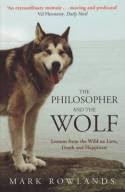
Book review: The Philosopher and the Wolf

During the course of our lives, if we are lucky – or unlucky depending on your own view – we will undergo a number of life-changing experiences. That the details of these experiences and their impact on us are unique to us and us only is not in dispute. What is curious about these personally seismic events, though, is the strange phenomenon that we are only able to recognise the full implications of such experiences long after they have happened; when we have shaken the dust from our allegorical feet and thrown a backwards glance over our metaphorical shoulder.

As it is with all of us, so it was for Mark Rowlands. When he picked up that local newspaper on a hot summer day in Alabama and decided, on impulse, to buy a six week old wolf cub, I’m pretty sure that he had no concept that the consequences of his actions were going to change the rest of his life. His only worry was whether he had enough money in his bank account to pay for it. And so begins a remarkable story of how this young British professor of philosophy came to share the next eleven years with Brenin the wolf.

At one level, The Philosopher and The Wolf is a highly amusing and deeply moving memoir of the life and times of one man and his wolf. As both grow and mature and change - jobs, homes, continents, girlfriends - they provide, for each other, the only constants in each other’s lives. We watch Brenin as he grows from fluffy cub into 150lb adult; we observe his training and his interactions with dogs and other people; we prowl with the wolf as he hunts rabbits and chases birds as much as we see his human companion hunt jobs and chase girls.

If The Philosopher and the Wolf were just a memoir of a man’s life with a wolf, it would still be a great book. But what raises it to brilliance is what it shows us about what it is to be human. Or as Mark Rowlands describes it, the “certain thoughts that can only emerge in the space between a wolf and a man”. The philosopher holds a mirror up to himself and sees the reflection of the avaricious, deceitful ape standing beside the raw and honourable furry embodiment of the natural world. The author does not try to dodge the unflattering bullets of this comparison and never strays into the territory of anthropomorphism; indeed, I believe Mark would regard that as an unforgivable and insulting betrayal to the fundamental nature of what Brenin is. So the book is also uncomfortable at times in what it tells us about what we are; our own, very human, nature does not always look good in this glaring spotlight that misses no detail of our defects.

It is a rare book that keeps me compelled to keep on reading until the dawn chorus reminds me that it’s morning. Rarer still, perhaps, is a book on philosophy that delights, entertains, amuses and educates in such a way. If this book’s grand theme is that of evolution and how we came to be what we are, it is also a road map of one man’s personal evolution from what he was then and how he became what he is now. All the lessons that Mark learned about love, death and happiness were taught to him by his wolf, and I don’t mind admitting that I was in tears for most of the last quarter of the book. Ultimately, this book has moved me beyond measure; reading it really has been a life changing experience.

If you are examining any of the big questions in your own life, if you are looking to take a peep around the curtains at the machinery that lies behind why we act as we do, if you have a deep and non-sentimental regard for nature and creatures, this book could change your life too.


The Philosopher and the Wolf: Lessons from the Wild on Love, Death and Happiness is published by Granta (2009)


Mark Rowlands is now professor of philosophy at the University of Miami. His website is
www.markrowlandsauthor.com